Red, yellow, and green are known as the pan-African colors. They come from the flag of Ethiopia, the only country in Africa to largely keep its independence during the colonial era. Given that, these colors became very popular when the many former European colonies started gaining their independence after World War II. A little too popular, if you ask me.
Guinea
Guinea was a former French colony, and elected to simply swap the colors of the tricolore with the pan-African ones. Easy.
Mali
Okay. I see Mali’s simply taken Guinea’s flag and flipped it around. Creative!
Senegal
Ooh, look – this one has a little star!
Cameroon
And now for something completely different ... Yup, we’ve got a star, plus we switched the colors all around. Yeah baby!
More links:
Red, white, and black are the traditional colors of the German Empire:
Oddly, though, all the countries in this post are Arab, just like last week. These flags can all be traced back to 1952, when Egypt overthrew their king in favor of a republic. That, in turn, would inspire a whole slew of imitators.
Yemen
Yemen represents the purest (read, “most boring”) expression of this motif.
Iraq
I see Iraq has livened things up by throwing some words on there. I’m guessing these say something like – oh, I don’t know – “Iraq.”
Well, shows what I know. This one actually says allahu akhbar – “God is great.” Huh. Never heard that one before.
Syria
And this one has some little stars (apologies to Doctor Seuss and his Red Fish, Blue Fish). Two of them, to be exact.
Wondering where they came from? Interesting story … Turns out Syria and Egypt were once united, from 1958 to 1962. Egypt (see below) has moved on. Syria? Still pining away, I guess.
Even more interestingly, this was the original flag in this whole set. As you can see, it actually combined the same original colors as in the flags from last week. It’s only when Egypt moved on that green became less central.
Egypt
Egypt has livened things up with the ol’ “eagle of Saladdin.” The ol’ whuh?
So, Saladdin was this Arab dude from the Crusades. He, like, beat up on a bunch of Christians. That’s his shield and stuff.
Alternates
So, anybody up for mixing things up a little (though I'm thinking that might be frowned upon in the Arab world)? How about these two ideas:
Feel free to throw some stars or eagles or writing on either of them.
More links:
More pan colors. This time, though, we’re coming up with something for the countries that came about when the southern part of the Ottoman Empire broke apart (click here to go a little north).
In fact, would you believe there was a flag just for that event? It’s called the flag of the Arab Revolt, and looks like this:
The colors represent the main dynasties of the Muslim caliphate.
Jordan
This one dates all the way back to 1928, not too long after the Arab Revolt itself.
That star, by the way, is an Islamic star. The 7 points all stand for something or other. I forget.
Palestine
Not really a state, but … This flag was adopted in the 1960s by the PLO.
If you’re thinking all they did was take the flag of Jordan and ditch the star, you might be right.
Western Sahara
Never heard of Western Sahara? It used to belong to Spain and is just below Morocco, who rule most of the territory. What they’re not in charge of, these guys are.
If you’re thinking all they did was take the flag of Palestine and thrown in the moon and star – well, once again, you might be right.
Sudan
Though Sudan was not part of the Arab Revolt by a long shot, they decided to go with this cute little number after a coup in 1970. Previously, they had flown this very non-Arab looking thing:
Kuwait
Kuwait adopted this flag only in 1961, when they achieved full independence. Up until that time, they went with an all-red flag with a bunch of writing on it. As far as I know, this one’s the only national flag with that cool trapezoidy thing.
United Arab Emirates
Here’s another one that’s fairly recent – 1971. It was designed by some local dude, one Abdullah Mohammad Al Maainah. He himself admits that “sometimes people have mistaken the UAE flag for another country, because it has the same colours as other Arab countries that adopted the pan-Arab colours of the 1916 Arab revolution.” Well, why didn’t you think of that beforehand, Abdullah?
More links:
Ah, the pan-Slavic colors … Yup, this is our first brush with flags that were purposely meant to look alike and confuse us.
Russia
So, Russia’s the one that started this mess. Their flag dates all the way back to the 17th Century.
There’s a great story that Peter the Great came up with this design based on the flag of the Netherlands, a country which he greatly admired:
Unfortunately, that’s not totally true. The white-blue-red is a traditional color combination in Russia, based on the arms of the Duchy of Moscow. The Dutch influence may have come in the three horizontal stripes though.
That said, the Russian flag would definitely become a strong model for the Slavic countries that would become independent as the Ottoman Empire receded in the Balkans.
Serbia
Serbia, whose flag dates back to 1830, simply flipped Russia’s flag over and substituted a darker blue and red.
This is actually the country’s civil flag. The state flag includes a distinctive coat of arms, a little to the left of center:
Let’s go with this instead.
Slovenia & Slovakia
It’s like they’re twins – same name, same flag, same obscure part of Eastern Europe. How’s anybody supposed to tell ‘em apart? I’m not sure what we can do with these two.
Alternative
I’m surprised none of these countries simply switched the colors around a little:
Same general idea – but just enough difference that you can tell them apart. C’mon, people!
More links:
There’s a lotta countries out there. Given that, I’m not too surprised that there were some girls who wore the exact same dress to the party, if you know what I mean.
Cote d’Ivoire
The Cote d’Ivoire, AKA the Ivory Coast, was a former French colony that went with a variation of the tricolore. The orange is supposed to be represent the savannahs of the north part of the country, the green the forests of the south, and the white peace between the two regions.
Unfortunately, that combination looks a heck of a lot like Ireland’s.
Interestingly, the symbolism is much the same. In this one, though, the green stands for the Catholics in the south and the orange for Protestants in the north.
Now, you could say that simply switching the stripe that appears at the host is enough to tell the difference between these two. I, however, think we can do a little better than that.
For example, what if we were to introduce one of the pan-African colors into the Ivorian flag:
We can say that it symbolizes the wealth of the country, or the sun that shines on all Ivorians, or whatever you like …
Niger
Niger is another west African country and former French Colony that has elected to go with an orange-white-green scheme.
Unfortunately, that also makes it look a lot like India’s:
(By the way, the symbolism in the Indian flag is very similar to that of Ireland’s. In India’s case, though, we’ve got Hindu orange and Muslim green.)
So, let’s go ahead and throw in some yellow on this one too (Niger’s, not India’s):
Done!
More links:
There’s a lotta countries out there. Given that, I’m not too surprised that there were some girls who wore the exact same dress to the party, if you know what I mean.
Hungary
Hungary’s flag dates back to 1848, when the Hungarians rose up against the Hapsburgs. The color scheme is an ancient one, and the French tricolore provided inspiration for the stripes.
There is an alternate (and the official flag between 1918 and 1946) that includes a coat of arms:
Time to go back, I say.
Iran
Another traditional design, this was formerly shown with a lion and sun:
The current symbol is called a tawhid, and somehow or other stands for the classic phrase “There is no God Except Allah.” The white fimbriations repeat “God is great” over and over again. In other words, I’m afraid the whole thing is a little on the churchy side.
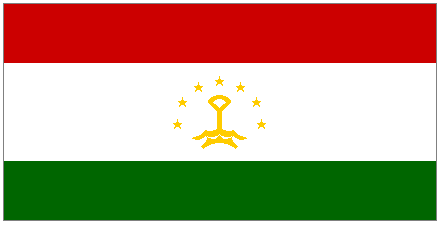
Tajikistan
It’s not official, but I’m seeing a little Iran in this baby. Indeed, the Tajiks speak a form of Farsi (the official language of Iran) and originally trace themselves back to the former Persia.
That things that looks like a bottle opener in the middle? Here, let me explain.
Somaliland
Never heard of Somaliland? Well, you’re not alone. It’s part of the wreck of the former Somalia, is not officially recognized, but pretty much functions as a real country. My son, who wrote his senior honors thesis on Somaliland, actually has a copy of this baby.
Italy
Forgive me if you’ve heard this before, but this is another variation on the French tricolore. The Italian version actually dates all the way back to 1797, just 3 years after the French version became official. The specific colors can be traced back to the city of Milan.
Mexico
Three vertical stripes? Red, white, and blue with one or two substitutions? You know the story, right?
This time, the colors date back to the Army of the Three Guarantees. This was the army that Agustin de Iturbide, the country’s first ruler, led into battle. Here’s what they actually flew:
I like it. Probably too late to go back, huh?
Alternative
Most of these are way too well established to offer much prospect for change. Here’s something that worked for the Czech Republic and the Philippines though – with green substituted for blue:
Feel free to switch the colors around, make things bigger or smaller, and throw some coats of arms or stars or bottle openers on there.
And then there’s this:
Any takers? Didn't think so.
More links:
There’s a lotta countries out there. Given that, I’m not too surprised that there were some girls who wore the exact same dress to the party, if you know what I mean.
Netherlands
The Dutch flag dates all the way back to the late 1500s. Interestingly, though, it was originally orange-white-blue, only officially switching in the 1930s:
Why not clear up some of the confusion here and just switch back?
Luxembourg
So, I realize we’ve turned the Dutch flag upside down, and are using a slightly different blue and red. I don’t know, though – I’m just not buyin’ it.
It’s actually not too surprising that these two flags are so similar. In fact, the two countries shared the same ruler until 1890.
The Luxembourgers do, however, sometimes use this very different “civil ensign” as a substitute:
I like it! Let’s make it official.
Paraguay
Not sure how these guys fit in. I guess a slightly darker red and some lame-o seal are all it takes, though, no?
Supposedly, Paraguay’s flag was influenced by France’s vertical tricolor. The Paraguayan flag dates all the way back to 1811 or so.
More links: